 Insights
The Supplier Is Also the Lender: Why Vendor-Financed Compute Needs a Conflict-Aware Asset Graph
Anthropic’s IPO prospectus reveals a financing structure in which Broadcom is not only a critical compute and hardware partner but may also provide up to $42 billion of financing tied to Anthropic’s five-year TPU compute commitments. Reuters reported that the convertible-note capacity could fund about one-third of Anthropic’s $125.2 billion TPU lease commitment, while Broadcom’s own SEC filing says the notes may be issued under certain circumstances and must be used for obligations under the...
This starts a temporary private draft. It is not public, listed for sale or shared automatically.
A supplier usually sells something.
A lender usually finances something.
A lessor grants another party the right to use an asset.
An equity investor owns part of the company.
Those roles are easy to understand when they belong to different institutions.
They become much harder to model when the same counterparty can occupy several of them at once.
That is now happening in AI infrastructure.
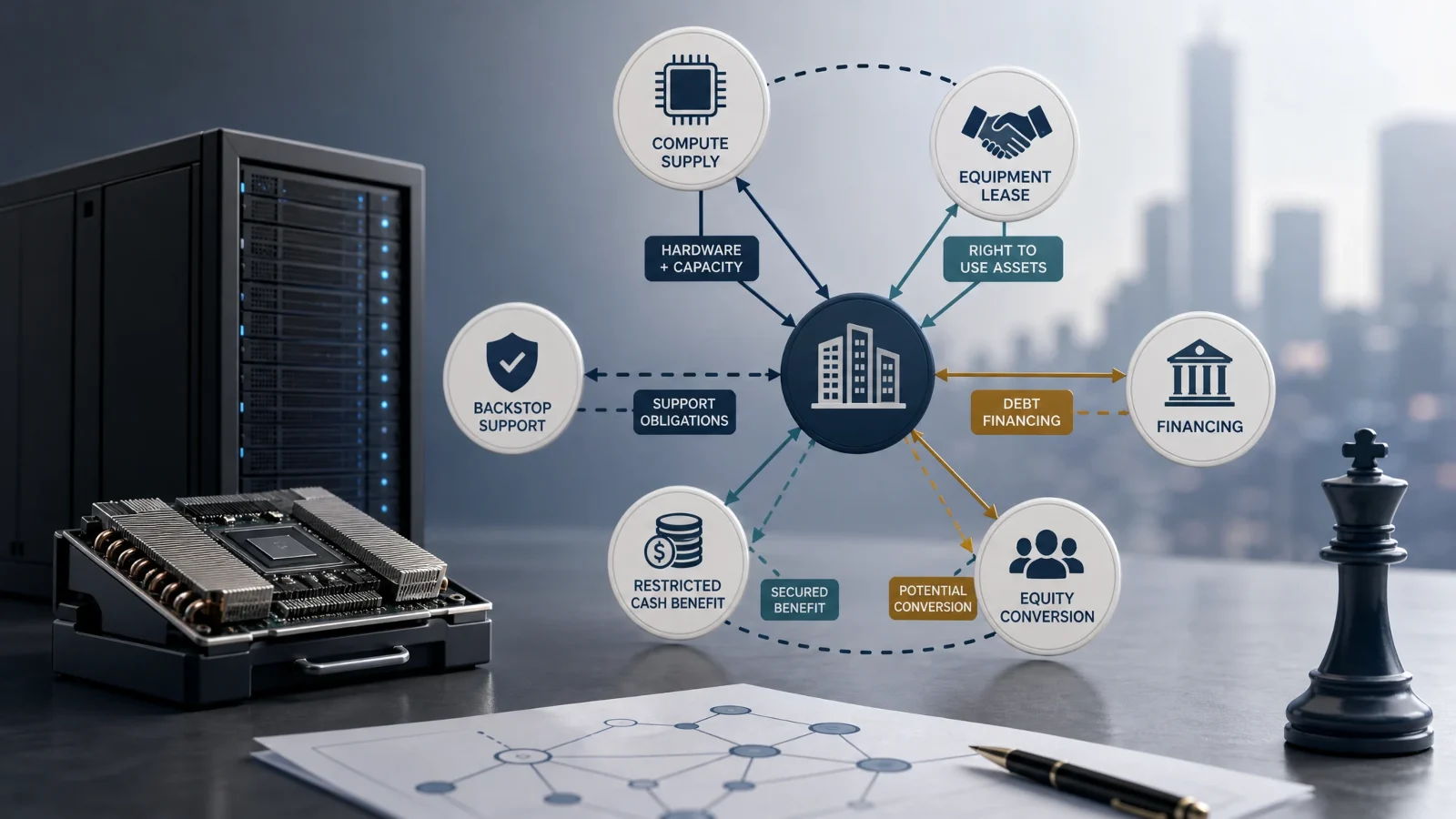
Anthropic’s IPO prospectus, as reported by Reuters, shows that Broadcom is not merely part of Anthropic’s compute supply chain.
The relationship spans:
Compute supply
Equipment leasing
Financing
Potential equity conversion
Reuters reported that Broadcom has agreed to make available up to:
$42 billion
of financing linked to Anthropic’s infrastructure commitments.
The financing could cover roughly one-third of Anthropic’s:
$125.2 billion
five-year TPU compute commitment.
Reuters: Broadcom to lend Anthropic up to $42 billion to lease its chips, filing says
The most important fact is not the amount.
It is the relationship graph.
A counterparty name is not a relationship.
The same institution can sit on several sides of the transaction
A weak system may record:
Counterparty: Broadcom
That tells a credit manager almost nothing.
The economically relevant questions are:
Broadcom as what?
Possible answers in this structure include:
- supplier;
- compute partner;
- participant in equipment-leasing arrangements;
- financing provider;
- backstop provider;
- potential equity holder; and
- party benefiting from restricted cash.
Those roles create different rights.
They create different triggers.
They create different exposures.
They should not be collapsed into one counterparty field.
Anthropic itself flags the conflict
Reuters reported that Anthropic’s prospectus identifies Broadcom’s overlapping role in:
Supplying hardware
+
Acting as financing partner
as creating:
Potential conflicts of interest
Anthropic also warned that Broadcom’s decisions around pricing and hardware availability could affect Anthropic’s ability to secure enough compute infrastructure.
That is not merely a corporate-governance footnote.
It is an asset-structure issue.
The supplier’s commercial decisions can affect the borrower’s ability to operate the very infrastructure that supports the financing relationship.
Supplier risk and lender risk become connected
In a conventional structure:
Supplier A
provides equipment.
Lender B
provides financing.
Their incentives are distinct.
In a vendor-financed structure:
Supplier A = Financier A
the same institution can influence both:
Cost of the asset
and:
Cost / availability of financing
That creates an interdependency the credit record should make explicit.
Compute capacity is not one asset
The phrase:
AI compute
can hide several different objects:
Custom accelerator design
AI racks
Physical data-center equipment
Lease right
Compute-capacity right
Service commitment
Financing obligation
Restricted cash
Convertible debt
Each can have a separate legal identity.
The lease obligation is not the hardware
Anthropic’s commitment is described as a five-year lease of TPU compute capacity.
The relevant investment object is not merely:
TPU
The economic relationship can include:
Hardware
    ->
Rack / infrastructure deployment
    ->
Lease
    ->
Compute-capacity entitlement
    ->
Lease-payment obligation
A lender evaluating the obligation needs more than a hardware inventory.
It needs the contract graph.
The financing is not the lease either
Broadcom’s SEC filing makes this distinction particularly clear.
Broadcom said that, in connection with lease agreements enabling a customer to access compute capacity, the customer may under certain circumstances issue Broadcom:
Convertible promissory notes
up to an aggregate principal amount of:
$42 billion
The proceeds from those notes, if issued, are restricted to obligations under the relevant lease agreements.
As of 2 August 2026:
No notes had been issued
SEC: Broadcom Form 10-Q for quarter ended 2 August 2026
That produces two separate assets:
Lease obligation
and:
Convertible financing instrument
The financing supports the lease.
It is not the lease.
Available financing is not drawn financing
The headline number is:
Up to $42bn
A system should never transform that automatically into:
Debt outstanding: $42bn
The relevant states may be:
Maximum facility / note capacity
Amount legally available
Amount issued
Amount funded
Amount outstanding
Amount repaid
Amount converted
Amount cancelled
All of those can differ.
At 2 August:
Maximum potential note principal: $42bn
Actual notes issued: $0
Those are radically different states.
Financing availability may depend on conditions
The notes are not an unconditional pile of cash waiting in Anthropic’s account.
Broadcom says they may be issued:
under certain circumstances and if needed
and are subject to conditions.
Reuters reported that certain payment or performance defaults could constrain Anthropic’s ability to use the financing facility.
That means:
Maximum financing capacity
does not necessarily equal:
Available financing after default
Credit infrastructure needs both.
The financing can become equity
Reuters reported that the debt instruments could be converted into Anthropic shares.
That creates another lifecycle:
Convertible debt
    ->
Conversion trigger / election
    ->
Equity
If conversion occurs, Broadcom’s relationship can change from:
Creditor
to:
Shareholder
or to a combination of roles if other obligations remain.
A counterparty master should not overwrite the old role.
It should add the new one.
Debt conversion changes incentives
A lender generally cares about repayment.
An equity investor generally cares about enterprise value.
A supplier cares about sales.
A lessor cares about lease payments.
The same institution can therefore hold rights whose incentives are not identical.
That is why role identity matters.
Restricted cash creates another asset
Reuters reported that Anthropic deposited cash into a restricted account for Broadcom’s benefit in April 2026 and may have to add further amounts under certain circumstances.
That creates another distinct asset state:
Cash provided by Anthropic
but:
Restricted for Broadcom benefit
This is not ordinary operating cash.
It should not be counted as though it were fully available liquidity.
Cash balance and available cash are different
A treasury system might show:
Cash: $X
But economically:
Unrestricted cash
and:
Restricted cash
answer different questions.
For financing analysis, the relevant graph is:
Total cash
    ->
Restricted account
    ->
Beneficiary
    ->
Release conditions
The restrictions need their own provenance.
Restricted cash is not necessarily collateral in the same sense as a pledge
Another common modelling error is to assume:
Restricted cash = collateral
The exact legal character depends on the governing documents.
It may be security, a reserve, a deposit, performance support, a payment reserve or another restricted-account structure.
The Asset Passport should store the documented legal role rather than infer it from economic similarity.
Default can affect several contracts at once
Reuters reported another critical point.
Certain:
Payment defaults
or:
Performance defaults
could cause a substantial portion of Anthropic’s lease obligations to become:
Immediately due
while simultaneously limiting Anthropic’s ability to use the $42 billion financing to cover those payments.
That is a powerful example of cross-contract state.
Default is not one boolean
A weak system may store:
Default: Yes
But the real questions are:
Default under which contract?
Which obligation triggered it?
Which other contract is affected?
What becomes accelerated?
What financing becomes unavailable?
The structure may look like:
Lease performance default
    ->
Lease acceleration
    ->
Financing availability reduced
The exact mechanics depend on the governing documents.
The graph must support them.
Acceleration changes timing, not necessarily principal
Suppose lease obligations were originally payable over years.
A default can make a substantial portion immediately due.
The nominal obligation may not have increased.
The timing changed dramatically.
That can transform liquidity risk.
A system therefore needs:
Original payment schedule
Current payment schedule
Acceleration state
Acceleration date
Accelerated amount
Broadcom’s own filing shows another financial layer: a backstop
Broadcom’s 10-Q separately describes a structure in which a financial partner took on certain agreements to purchase AI racks and the related lease agreements with a customer.
Broadcom entered into a:
Backstop agreement
with that financial partner.
The backstop grows as AI racks are delivered and deployed and declines as the customer makes lease payments.
Broadcom disclosed a maximum potential undiscounted liability, after full deployment, of approximately:
$29 billion
As of 2 August 2026:
No amounts had been paid under the Backstop
This is a separate instrument from the $42 billion convertible-note capacity.
A backstop is not a loan
The backstop creates a contingent obligation.
It may never result in a cash payment.
The convertible notes create another potential financing exposure.
Therefore:
$29bn backstop
should not be added mechanically to:
$42bn financing capacity
and called:
$71bn loan exposure
That would be wrong.
The two structures have different triggers and different states.
Contingent liability needs its own lifecycle
The backstop can move:
Agreement signed
    ->
AI racks deployed
    ->
Backstop amount grows
    ->
Lease payments made
    ->
Backstop amount declines
If default occurs:
Lease default
    ->
Asset sale
    ->
Recovery value determined
    ->
Backstop liability calculated
    ->
Broadcom payment potentially required
That is not a standard loan lifecycle.
It deserves its own object.
Hardware value enters the backstop calculation
Broadcom says that, if the customer defaults, its backstop liability is calculated by reference to 85% of the outstanding amount owed under the lease backstop less the value realised from AI racks.
That introduces the physical hardware into the financing graph:
Lease obligation
    ->
AI racks
    ->
Asset-sale value
    ->
Backstop liability
This is exactly why the hardware cannot be ignored.
Compute supply and equipment value are different
Anthropic’s business need is:
Compute capacity
The backstop may rely partly on:
Physical AI racks
Those are different economic objects.
The compute can be extremely valuable while the underlying hardware depreciates.
Or the racks can retain resale value while the contracted compute service loses strategic relevance.
A structured system should preserve both.
Delivery is a financing event
Broadcom’s backstop grows as racks are delivered and deployed.
That means operational milestones can change:
- lease commencement;
- payment obligation;
- backstop exposure;
- financing need;
- revenue recognition; and
- counterparty exposure.
Therefore:
Equipment delivered
is not merely an operational field.
It is a financing event.
Acceptance is another event
A strong record may distinguish:
Ordered
Manufactured
Delivered
Installed
Commissioned
Accepted
Compute available
Lease payment commenced
The financing lifecycle may depend on one or more of those milestones.
Vendor financing can hide concentration risk
Anthropic is expected, according to Reuters, to become Broadcom’s largest compute customer in 2027.
That creates concentration on both sides.
Anthropic can become highly dependent on Broadcom for:
- hardware;
- capacity;
- pricing;
- lease structure; and
- financing.
Broadcom can become highly exposed to Anthropic through:
- sales;
- lease economics;
- backstop obligations;
- note exposure; and
- potential equity conversion.
One relationship can therefore concentrate:
Commercial risk
+
Credit risk
+
Asset risk
+
Equity risk
Counterparty concentration should be role-specific
A treasury system might say:
Broadcom exposure: $X
But a better system decomposes:
Payables to Broadcom
Lease obligations to Broadcom-linked structures
Restricted cash for Broadcom benefit
Convertible-note exposure
Hardware-supply dependence
Backstop-related exposure
Potential equity relationship
The total relationship is not one balance.
Reciprocal dependency can amplify stress
Suppose Anthropic experiences financial stress.
That could reduce its ability to pay leases, which could increase backstop risk.
At the same time, stress could reduce financing availability while accelerated lease payments increase liquidity need.
The feedback loop can become:
Operating stress
    ->
Payment / performance default
    ->
Lease acceleration
    ->
Financing constraint
    ->
Liquidity pressure
The system needs to model cross-contract triggers to see that loop.
Vendor finance can move risk upstream
A supplier that finances customers is doing more than growing revenue.
It is also absorbing or redistributing part of the customer’s financing problem.
That can move risk from:
Customer balance sheet
toward:
Supplier balance sheet
or:
Supplier-supported financing partner
The commercial relationship can therefore reshape the credit chain.
Revenue and financing exposure should not be netted conceptually
Broadcom may generate revenue from the relationship while also accepting contingent or funded exposure.
The same customer can be:
Largest revenue opportunity
and:
Largest financing concentration
at the same time.
Use-of-proceeds is part of the asset state
Broadcom’s 10-Q says the notes or their proceeds, if any, must be used solely for obligations under the relevant lease agreements.
Therefore:
Cash raised
does not necessarily equal:
General corporate liquidity
A credit record should distinguish restricted financing proceeds from unrestricted cash.
Financing partner identity may change the relationship graph
Reuters reported that Broadcom may designate a financing partner.
That means the ultimate creditor may not always be Broadcom itself.
The structure could become:
Broadcom
    ->
Designates financing partner
Financing partner
    ->
Holds debt instrument
while Broadcom remains supplier or retains other rights.
The current lender should therefore not be inferred permanently from the original arrangement.
Assignment should be event-driven
If a financing partner becomes holder, the system should record:
Original financing provider
Designated financing partner
Assignment / issuance date
Principal amount
Current holder
Broadcom retained rights
The debt identity should survive the holder change.
Supplier role should not move with the debt automatically
If Broadcom assigns the financing to another institution:
Lender changes
but:
Supplier may remain Broadcom
That demonstrates again why roles must be separate objects.
Equity conversion creates another relationship fork
If convertible notes become equity:
Debt principal
may fall or disappear.
At the same time:
Equity position
may appear.
The relationship graph changes:
Creditor
    ->
Shareholder
The history should remain visible.
A conflict-aware Asset Passport
A useful DaDepo-style structure for vendor-financed compute could contain several linked sections.
Counterparty identity
- legal entity;
- group;
- jurisdiction;
- LEI where available;
- parent;
- subsidiaries;
- effective dates;
- credit rating;
- public / private status; and
- source.
Relationship roles
For every counterparty:
- supplier;
- lessor;
- service provider;
- financier;
- note holder;
- backstop provider;
- equity holder;
- financing partner;
- beneficiary of restricted cash;
- guarantor;
- effective from;
- effective to; and
- source.
Compute commitment
- compute provider;
- capacity;
- hardware family;
- TPU generation;
- gigawatts;
- deployment site;
- contracted start;
- service term;
- pricing;
- minimum commitment;
- cancelability;
- acceptance criteria;
- service-level obligations; and
- current delivery state.
Equipment / lease
- lease identifier;
- lessor;
- lessee;
- equipment;
- rack identifier;
- delivery tranche;
- commencement date;
- payment schedule;
- residual value;
- default trigger;
- acceleration clause;
- termination rights; and
- current lease state.
Financing facility / convertible notes
- maximum principal;
- issuer;
- lender / note holder;
- financing partner;
- availability condition;
- note issuance date;
- notes issued;
- current principal;
- interest;
- maturity;
- permitted use of proceeds;
- draw restrictions;
- conversion terms;
- conversion state;
- repayment state; and
- current availability.
Restricted cash
- account;
- depositor;
- beneficiary;
- amount;
- currency;
- deposit date;
- top-up requirement;
- release condition;
- withdrawal restriction;
- control rights;
- current balance; and
- current restriction state.
Backstop
- backstop provider;
- financial partner;
- covered lease;
- maximum exposure;
- current exposure;
- deployment-linked increase;
- payment-linked decrease;
- default trigger;
- asset-sale offset;
- recovery mechanism;
- amount paid; and
- current contingent state.
Default and acceleration
- triggering contract;
- default type;
- payment default;
- performance default;
- cure period;
- cross-contract consequence;
- accelerated amount;
- acceleration date;
- financing availability impact;
- restricted-cash consequence;
- termination right; and
- current status.
Equity conversion
- convertible instrument;
- conversion trigger;
- conversion election;
- conversion price;
- shares issued;
- voting rights;
- holder;
- effective date; and
- post-conversion role.
Conflict map
- counterparty;
- role A;
- role B;
- potential conflict;
- affected decision;
- pricing dependency;
- supply dependency;
- financing dependency;
- governance / approval;
- mitigation;
- disclosure source; and
- current state.
Provenance
- supply agreement;
- lease agreement;
- financing agreement;
- convertible note;
- restricted-account agreement;
- backstop agreement;
- equipment schedule;
- acceptance certificate;
- payment record;
- SEC filing;
- IPO prospectus;
- company announcement;
- AI-extracted field;
- professional review;
- effective date; and
- last-updated timestamp.
This turns:
Broadcom relationship
into an inspectable contractual graph.
Relationship state should be machine-readable
A relationship may begin:
Supplier
then become:
Supplier + backstop provider
then:
Supplier + financing provider
then:
Supplier + creditor
and potentially:
Supplier + shareholder
The counterparty is unchanged.
The rights graph evolves.
Financing state should be machine-readable
The $42 billion note arrangement illustrates a path such as:
Maximum capacity agreed
    ->
Conditions pending
    ->
Available
    ->
Note issued
    ->
Funded
    ->
Outstanding
    ->
Repaid
or:
Outstanding
    ->
Converted
    ->
Equity
or:
Default
    ->
Further financing restricted
A single field:
Facility: $42bn
cannot represent this.
Backstop state is different again
The backstop may move:
Agreement active
    ->
Racks deployed
    ->
Exposure increases
    ->
Lease payments received
    ->
Exposure decreases
or:
Lease default
    ->
Rack sale
    ->
Residual shortfall
    ->
Backstop payment
That is a contingent-liability lifecycle, not debt principal.
AI can reconstruct the relationship graph
AI can help extract:
- supplier identities;
- lease commitments;
- compute capacity;
- equipment tranches;
- financing caps;
- note issuances;
- restricted cash;
- backstop exposure;
- conversion rights;
- default triggers;
- acceleration clauses;
- financial partners;
- deployment milestones; and
- payment history.
Across a complex relationship, AI could flag:
- $42bn maximum financing recorded as debt outstanding;
- $29bn backstop added to funded debt;
- supplier and lender collapsed into one role;
- restricted cash counted as unrestricted liquidity;
- lease obligation treated as hardware ownership;
- convertible debt treated as equity before conversion;
- financial-partner debt still shown as Broadcom-held;
- default acceleration missing from liability schedule;
- financing availability not reduced after a trigger;
- delivered racks not linked to backstop exposure;
- hardware residual value missing from a default scenario;
- lease payments and note repayments double-counted;
- counterparty concentration measured only on revenue; or
- obsolete contract version driving current exposure.
That can materially improve credit analysis.
AI should not decide the conflict
AI should not independently conclude:
- that Broadcom acted against Anthropic’s interests;
- that a conflict caused economic harm;
- that a financing condition has been satisfied;
- that a lease accelerated;
- that a default occurred;
- that financing is legally unavailable;
- that restricted cash may be released;
- that a backstop is payable;
- that the hardware has a particular residual value;
- that a convertible note should convert;
- that vendor financing is abusive;
- that revenue is improperly recognised; or
- that the arrangement is legally problematic.
Those require governing documents, accounting rules and professional judgment.
What DaDepo can contribute
DaDepo does not need to finance Anthropic.
It does not need to sell AI chips.
The useful role is information infrastructure.
An Asset Passport can connect:
Supplier
    ->
Compute commitment
    ->
Equipment / lease
    ->
Lease-payment obligation
    ->
Financing capacity
    ->
Convertible note
    ->
Restricted cash
    ->
Backstop
    ->
Default trigger
    ->
Acceleration
    ->
Potential equity conversion
That can make it easier to answer:
- what Broadcom supplies;
- what Anthropic leases;
- which obligations are fixed;
- what financing is merely available;
- what financing has actually been issued;
- what cash is restricted;
- who benefits from that restriction;
- which financial partner holds risk;
- what Broadcom backstops;
- what happens after payment or performance default;
- what becomes accelerated;
- whether financing remains available;
- whether debt can convert to equity;
- which contractual role creates each conflict; and
- which source supports every state.
DaDepo does not resolve conflicts.
It makes the relationship graph inspectable.
What DaDepo does—and does not do
Creating or reviewing a vendor-finance Asset Passport does not mean that DaDepo has:
- supplied compute;
- leased hardware;
- provided financing;
- issued convertible debt;
- determined financing availability;
- controlled restricted cash;
- provided a financial guarantee;
- valued AI racks;
- determined residual value;
- determined a payment or performance default;
- accelerated a lease;
- converted debt to equity;
- determined that a conflict exists legally;
- determined that any counterparty breached duties;
- audited revenue recognition;
- assessed solvency;
- recommended a financing structure; or
- provided lending, leasing, accounting, legal, tax, investment or valuation advice.
Important: DaDepo provides technology and information tools. It does not provide lending, vendor finance, equipment leasing, guarantees, brokerage, legal, accounting, tax, investment or valuation advice or services unless a specific service is expressly identified and lawfully provided. Financing availability, lease rights, restricted cash, backstop obligations, default triggers, acceleration, conversion and conflicts depend on governing documents, authoritative records, applicable law and qualified professional review.
A practical vendor-finance checklist
Before a supplier-financed compute arrangement is treated as one exposure, ask:
- Counterparty: Which exact legal entities are involved?
- Supplier: Who supplies the hardware or compute?
- Compute provider: Is that the same entity as the supplier?
- Lessor: Who owns or controls the leased equipment?
- Lessee: Which entity owes the lease payments?
- Financier: Who provides financing?
- Financing partner: Can another institution become lender or note holder?
- Backstop provider: Who bears contingent lease-default risk?
- Equity holder: Does any party already hold equity?
- Conversion right: Can debt turn into equity?
- Compute commitment: What capacity is contracted?
- Commitment value: What is the total payment commitment?
- Lease term: How long does the obligation run?
- Cancelability: Which obligations are non-cancellable?
- Delivery: Which equipment has actually been delivered?
- Deployment: Which racks are operational?
- Acceptance: Which tranches have been accepted?
- Lease commencement: When did payment obligations begin?
- Lease obligation: What amount is currently due over time?
- Financing maximum: What is the headline maximum financing capacity?
- Current availability: How much is legally available today?
- Issued notes: How much debt has actually been issued?
- Funded amount: How much cash has actually been advanced?
- Use of proceeds: What may financing proceeds be used for?
- Restricted cash: What cash is restricted?
- Beneficiary: Who benefits from the restriction?
- Top-up: When must additional restricted cash be posted?
- Release: When can restricted cash be released?
- Backstop maximum: What is the maximum contingent exposure?
- Current backstop: How much exposure currently exists?
- Asset offset: How does equipment resale value reduce backstop exposure?
- Default: Which payment or performance events constitute default?
- Cure: Is there a cure period?
- Acceleration: Which lease obligations can become immediately due?
- Financing restriction: Does default reduce access to financing?
- Termination: Which contracts can terminate after default?
- Conversion: What triggers debt-to-equity conversion?
- Post-conversion rights: What rights does the new shareholder obtain?
- Supplier pricing: Can the supplier alter pricing materially?
- Hardware allocation: Can supply decisions affect compute access?
- Conflict map: Which roles are held by the same counterparty?
- Mitigation: What governance or contractual controls address those overlaps?
- Concentration: How dependent is the customer on the supplier?
- Reverse concentration: How exposed is the supplier to the customer?
- Current exposure: Can funded, contingent and operational exposures be separated?
- Hardware value: What is the current residual value of deployed equipment?
- Payment history: Are lease payments current?
- Provenance: Can every role, amount and trigger be traced to a source and date?
If the answer to:
“Which role does this counterparty play in each contract, what does it own or finance today, and how does one contract change the state of another?”
is unclear, the vendor-finance record is incomplete.
The broader lesson goes beyond AI compute
The same structure appears across many private markets.
Aircraft finance
A manufacturer may provide customer financing or guarantees while also selling aircraft.
Equipment leasing
A vendor may arrange leases, residual-value support and financing through affiliated or partner entities.
Auto finance
Manufacturers frequently combine product sales with captive financing.
Renewable energy
Equipment suppliers can support project financing or performance guarantees.
Telecom infrastructure
Vendors may finance equipment that generates the revenues used to repay them.
Data centers
Hardware suppliers, tenants, lenders and project vehicles can overlap economically.
Trade finance
A supplier can extend payment terms while also funding the buyer through another instrument.
Private credit
Sponsors or strategic partners can provide both commercial contracts and rescue financing.
The rule is general:
When one counterparty occupies several contractual roles, exposure must be modelled by relationship, not by name.
The supplier is also the lender
That is the strongest lesson from the Broadcom–Anthropic structure.
Broadcom can be part of the compute supply chain.
It can be connected to equipment leasing.
It can support a financial partner through a backstop.
It can receive convertible debt.
It may ultimately become an equity holder through conversion.
It benefits from restricted cash.
Anthropic depends on the same broader relationship for compute capacity.
The financing is designed to help fund obligations generated by the compute relationship itself.
Those facts can all be true without being one contract.
The correct model is not:
Counterparty: Broadcom
Exposure: $42bn
It is closer to:
Broadcom
    ->
Supplier role
    ->
Compute capacity

Broadcom / partner structure
    ->
Lease role
    ->
Lease obligation

Broadcom
    ->
Financing role
    ->
Convertible-note capacity

Anthropic
    ->
Restricted cash
    ->
Broadcom benefit

Broadcom
    ->
Backstop role
    ->
Financial partner

Convertible debt
    ->
Potential conversion
    ->
Equity relationship
Each edge has its own amount.
Each edge has its own trigger.
Each edge has its own lifecycle.
And some edges can change the state of others.
A counterparty name is not a relationship. When the same institution supplies the asset, finances its use and can become an equity holder, every contractual role needs its own identity and lifecycle.
That is why vendor-financed compute needs a conflict-aware asset graph.
Further reading
- Reuters: Broadcom to lend Anthropic up to $42 billion to lease its chips, filing says
- SEC: Broadcom Form 10-Q for quarter ended 2 August 2026
- Broadcom: April 2026 Form 8-K on expanded Google and Anthropic compute collaboration
- Anthropic: Expanded partnership with Google and Broadcom for next-generation compute
- Reuters: Anthropic's $518 billion AI buildout hinges largely on deals that cannot be canceled